
Motivation
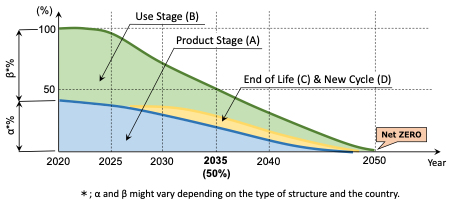
In 2020, many countries, including the EU and Japan, declared their commitment to carbon neutrality by 2050. This movement has gained momentum, particularly after the COVID-19 pandemic, with over 100 countries now involved. Despite the significant CO2 emissions of the concrete sector, concrete remains an essential material for human prosperity. To achieve sustainability goals, the world will require concrete structures with minimal CO2 emissions in the near future. Clients and taxpayers may begin to demand that designers, constructors, and owners quantify the CO2 emissions of their projects properly. In this context, the fib must be prepared to lead the change in the structural concrete community. It is essential that the fib shares its knowledge and provides proper methodological approaches to enable a reliable assessment of the environmental impact of concrete structures.
Scope and objective of technical work
To achieve its goal, the SAG will focus on three objectives:
- Establishing a comprehensive database of environmental impact data for structural materials used in concrete structures. The SAG will prioritize data related to the construction stage, but will also develop a strategy to manage data from the operational and maintenance stages, as well as the dismission stage. The data platform will need to be continuously maintained by collecting new data and updating existing data, with a focus on different lifecycle stages in different geographical areas. The SAG will source this data from manufacturers, designers, associations, and other institutions.
- Defining a reliable methodological approach to support designers in quantifying the environmental impact of concrete structure projects. The methodology will be based on LCA principles and focus on the requirements and performance of structures. The approach will be easily implementable and usable in the design process, with a common set of indicators and proper metrics established to compare data and allow for the definition of benchmarks. The methodology may also identify a Product Category Rule, according to the ISO 14000 series, to enable designers to produce EPDs for individual concrete structures.
- Identifying the best tools and knowledge to guide the decision-making process towards optimal structural solutions in terms of environmental impact while still satisfying expected structural and functional performances. The SAG will suggest proper optimization strategies and procedures and identify best practices for different structures, in various market conditions and geographical areas.
Domenico Asprone

TBT
| First name | Last name | Country | Affiliation |
|---|---|---|---|
| Asprone | Domenico | Italy | University of Naples Federico II |
| Fernández-Ordóñez | David | Switzerland | fib |
| Pirttikoski | Kasperi | Finland | Ramboll Finland |
| Nuti | Camillo | Italy | Università degli Studi Roma Tre |
| Kessler | Sylvia | Germany | Helmut-Schmidt-University/ University of the Federal Armed Forces Hamburg |
| Kasuga | Akio | Japan | School of Engineering |
| De la Fuente | Albert | Spain | Universitat Politècnica de Catalunya |
| Camci | Ladin | United Kingdom | CARES (Certification Authority for Reinforcing Steels) |
| Bigaj-van Vliet | Agnieszka | Netherlands | TNO - Buildings, Infrastructures and Maritime |
| Gálvez Ruiz | Jaime | Spain | Universidad Politecnica de Madrid |
| Von Greve-Dierfeld | Stefanie | Switzerland | Office fédéral des routes OFROU |
| Stürwald | Simone | Switzerland | Private |
| Ferrara | Liberato | Italy | Politecnico di Milano |
| Martius-Hammer | Tor | Norway | SINTEF AS |
| Heggade | Venkataramana | India | Indian National Academy of Engineers |
| Parisi | Fulvio | Italy | University of Naples Federico II |
| Menna | Costantino | Italy | University of Naples Federico II |
| Plauska | Tomas | Netherlands | Consolis |
| Moro | Fabrizio | Switzerland | |
| Reggia | Adriano | Italy | |
| SANTINI | Silvia | Italy | |
| Bernardi | Patrizia | Italy | University of Parma |
| Belletti | Beatrice | Italy | Univ. degli Studi di Parma - Engineering and Architecture |
| Borg | Ruben Paul | Malta | University of Malta |
| van den bos | ab | Netherlands | NLyse |
| Subbarao | Harshavardhan | India | Construma Consultancy Pvt. Ltd. |
| Salvador Filho | José Américo | Brazil |
TG.SAG1.1 - fib Database
The TG.SAG1.1 aim to establish a comprehensive database of environmental impact data for structural materials used in concrete structures. The TG.SAG1.1 will prioritize data related to the construction stage, but it will also develop a strategy to manage data from the operational and maintenance stages, as well as the dismission stage. The data platform will need to be continuously maintained by collecting new data and updating existing data, with a focus on different lifecycle stages in different geographical areas. The TG.SAG1.1 will source this data from manufacturers, designers, associations, and other institutions.

| First name | Last name | Country | Affiliation |
|---|---|---|---|
| Menna | Costantino | Italy | University of Naples Federico II |
| Fernández-Ordóñez | David | Switzerland | fib |
| Asprone | Domenico | Italy | University of Naples Federico II |
| Pirttikoski | Kasperi | Finland | Ramboll Finland |
| Borg | Ruben Paul | Malta | University of Malta |
| Passoni | Chiara | Italy | University of Bergamo |
| Palumbo | Elisabetta | Italy |
TG. SAG1.2 - Sustainable Concrete Structures
The TG.SAG1.2 is complementary to TG.SAG1.1. It will address best practices, design methodologies and the decision-making process for non-conventional solutions for sustainable concrete structures, aligned with scope and objective of technical work. The detailed timeline of work will deviate for the various WPs.
Further development of design practices for sustainable concrete structures is an essential step towards making a meaningful contribution to the global effort to achieve carbon neutrality by 2050.
To achieve this goal, the TG.SAG1.2 Sustainable Concrete Structures will focus on the following objectives:
- Identifying the best practices and optimal structural solutions in terms of environmental impact, fit for various market conditions and geographical areas: The TG.SAG1.2 focus on exploring a range of material, structural, and technological innovations to enhance the sustainability of concrete structures. These innovations will encompass various aspects, including nonconventional materials, structural designs, construction technologies, maintenance and interventions approaches, and circular use (e.g. reuse of reclaimed elements). While ongoing fib activities have addressed some of these areas, the TG.SAG1.2 will specifically target those aspects that have not yet been addressed within fib activities.
- Enabling performance-based design of sustainable structures in a life cycle perspective: The TG.SAG1.2 will work towards the consistent implementation of the safety philosophy for structural design across a wide range of innovative solutions (in particular for solutions that are currently outside the scope of Model Code 2020). This implementation will involve careful reconsideration of reliability requirements and uncertainties treatment in verification of structural performance. The TG.SAG1.2 will also formulate principles for an equivalent performance approach to structural design with innovative (material) solutions and establish basis for operational provisions for performance evaluation supported by material and structural testing of innovative solutions.
- Identifying the best tools to guide the decision-making process towards optimal structural solutions in terms of environmental impact, while meeting the desired structural and functional and economic performances requirements: The TG.SAG1.2 will elaborate the objectives and methodologies for a multi-criteria decision-making process aimed at achieving sustainable structural solutions through sustainability-oriented optimization of design. It will also propose effective strategies and procedures to ensure that decisionmaking at various design stages supports the successful accomplishment of these objectives.
The TG.SAG1.2 will reach these objectives by working in 6 Working Parties.
Agnieszka Bigaj
Eline Vereecken
| First name | Last name | Country | Affiliation |
|---|---|---|---|
| Bigaj-van Vliet | Agnieszka | Netherlands | TNO - Buildings, Infrastructures and Maritime |
| Fernández-Ordóñez | David | Switzerland | fib |
| Pirttikoski | Kasperi | Finland | Ramboll Finland |
| Borg | Ruben Paul | Malta | University of Malta |
| Hajek | Petr | Czech Republic | Czech Technical University in Prague |
| Belletti | Beatrice | Italy | Univ. degli Studi di Parma - Engineering and Architecture |
| Davolio | Marco | Italy | Politecnico di Milano |
| diSumma | Davide | Belgium | Ghent University |
| Ferrara | Liberato | Italy | Politecnico di Milano |
| Asprone | Domenico | Italy | University of Naples Federico II |
| Scrivener | Karen | Switzerland | EPFL |
| Plizzari | Giovanni | Italy | University of Brescia |
| Allaix | Diego Lorenzo | Netherlands | TNO Neitherlands |
| Kasuga | Akio | Japan | School of Engineering |
| De la Fuente | Albert | Spain | Universitat Politècnica de Catalunya |
| Minoretti | Arianna | Norway | Statens vegvesen |
| Edvardsen | Carola K. | Denmark | Cowi AS |
| Marsili | Francesca | Germany | Helmut-Schmidt-University/ University of the Federal Armed Forces Hamburg |
| Josa | Irene | United Kingdom | University College London (UCL) |
| Torrenti | Jean Michel | France | Univ Gustave Eiffel |
| di Prisco | Marco | Italy | Politecnico di Milano |
| Haist | Michael | Germany | |
| Caspeele | Robby | Belgium | Ghent University |
| Hansen | Søren | Denmark | COWI SA |
| Von Greve-Dierfeld | Stefanie | Switzerland | Office fédéral des routes OFROU |
| Matthews | Stuart | United Kingdom | Matthews Consulting |
| Kessler | Sylvia | Germany | Helmut-Schmidt-University/ University of the Federal Armed Forces Hamburg |
| Heggade | Venkataramana | India | Indian National Academy of Engineers |
| van den bos | ab | Netherlands | NLyse |
| Müller | Harald | Germany | SMP Ingenieure im Bauwesen GmbH |
| Bujnak | Jan | Slovakia | Peikko Group |
| Campos e Matos | José | Portugal | University of Minho |
| Unger | Jörg | Germany | Bundesanstalt für Materialforschung und -prüfung, BAM |
| Marini | Alessandra | Italy | University of Bergamo |
| Strauss | Alfred | Austria | BOKU University |
| Dunant | Cyrille | United Kingdom | Cambridge University |
| Lavorato | Davide | Italy | Università Roma Tre, Italia |
| Bergmeister | Konrad | Austria | Univ. Bodenkultur |
| Camci | Ladin | United Kingdom | CARES (Certification Authority for Reinforcing Steels) |
| Bernardi | Patrizia | Italy | University of Parma |
| Spagnuolo | Simone | Italy | University of Rome "Tor Vergata" |
| Stürwald | Simone | Switzerland | Private |
| Martius-Hammer | Tor | Norway | SINTEF AS |
| Gálvez Ruiz | Jaime | Spain | Universidad Politecnica de Madrid |
| Minson | Andrew | United Kingdom | GCCA |
| John | Vanderley | Brazil | USP |
| Passoni | Chiara | Italy | University of Bergamo |
| Sirico | Alice | Italy | |
| Muciaccia | Giovanni | Italy | Politecnico di Milano |
| Boros | Vazul | Germany | AIT Austrian Institute of Technology |
| Ammann | Rebecca | Switzerland | |
| Reggia | Adriano | Italy | |
| Meda | Alberto | Italy | University of Rome “Tor Vergata” |
| Nuti | Camillo | Italy | Università degli Studi Roma Tre |
| Ruggiero | David | Switzerland | EPFL ENAC |
| Teixeira | Elisabete | Portugal | ISISE |
| Moro | Fabrizio | Switzerland | |
| Jalayer | Fatemeh | Italy | University of Naples Federico II |
| Romeo | Francesco | Italy | |
| Zani | Giulio | Italy | Politecnico di Milano |
| Köhler | Jochen | Norway | NTNU |
| Cyr | Martin | France | Université de Toulouse |
| Gravina | Rebecca | Australia | The University of Queensland |
| Vergoossen | Rob | Netherlands | Haskoning |
| SANTINI | Silvia | Italy | |
| Foster | Stephen | Australia | UNSW Sydney |
| Ueda | Tamon | China | Shenzhen University |
| Borghese | Vittoria | Netherlands | TNO |
| Margiotta Nervi | Elisabetta | Belgium | Fondation Pier Luigi Nervi |
| Yrjölä | Jaakko | Finland | Peikko |
| Poljansek | Martin | Italy | Joint Research Centre in Ispra |
| Spada | Matteo | Switzerland | ZHAW |
| Bertin | Matthieu | Ireland | Ecocem |
| Lastunen | Auli | Finland | |
| Hingorani | Ramon | Norway | SINTEF |
| Vereecken | Eline | Belgium | Hasselt University |
| Pinto | José Rui | Portugal | Krear Construção Industrializada S.A |
| Kanavaris | Fragkoulis | United Kingdom | Arup |
| Parisi | Fulvio | Italy | University of Naples Federico II |
| Ancey | Emilien François | Switzerland | EPFL |
| Bertola | Numa | Luxembourg | University of Luxembourg |
| Górski | Marcin | Poland | Silesian University of Technology |
| Gwon | Seongwoo | Korea, Republic of | Hankyong National University |
| Kovaleva | Daria | Germany | |
| Küpfer | Célia | Canada | |
| Nigl | David | Germany | Universität Stuttgart |
| Paredes | José | Netherlands | Nebest |
| Goldmann | Eryk | Poland | Silesian University of Technology |
| Santamaria-Ariza | Monica | Portugal | University of Minho |
| Malchiodi | Beatrice | Switzerland | EPFL |
| BENTO | RICARDO | Brazil | |
| Choi | Jongkwon | Korea, Republic of | Hongik University |
Eline Vereecken
Agnieszka Bigaj
| First name | Last name | Country | Affiliation |
|---|---|---|---|
| Fernández-Ordóñez | David | Switzerland | fib |
| Vereecken | Eline | Belgium | Hasselt University |
| Bigaj-van Vliet | Agnieszka | Netherlands | TNO - Buildings, Infrastructures and Maritime |
| First name | Last name | Country | Affiliation |
|---|---|---|---|
| Fernández-Ordóñez | David | Switzerland | fib |
| Josa | Irene | United Kingdom | University College London (UCL) |
| Borghese | Vittoria | Netherlands | TNO |
| Ammann | Rebecca | Switzerland | |
| Spada | Matteo | Switzerland | ZHAW |
| Passoni | Chiara | Italy | University of Bergamo |
| Marsili | Francesca | Germany | Helmut-Schmidt-University/ University of the Federal Armed Forces Hamburg |
| Strauss | Alfred | Austria | BOKU University |
| Minoretti | Arianna | Norway | Statens vegvesen |
Marco di Prisco
Francesco Romeo
| First name | Last name | Country | Affiliation |
|---|---|---|---|
| Fernández-Ordóñez | David | Switzerland | fib |
| di Prisco | Marco | Italy | Politecnico di Milano |
| Romeo | Francesco | Italy | |
| Balázs | György L. | Hungary | Budapest Univ. of Techn. & Economics |
| A. O. Barros | Joaquim | Portugal | Universidade do Minho |
| Belletti | Beatrice | Italy | Univ. degli Studi di Parma - Engineering and Architecture |
| Borghese | Vittoria | Netherlands | TNO |
| Chiorino | Mario Alberto | Italy | Politecnico di Torino |
| Lenticchia | Erica | Italy | |
| Margiotta Nervi | Elisabetta | Belgium | Fondation Pier Luigi Nervi |
| Multari | Giovanni | Italy | Corvino + Multari |
| Muttoni | Aurelio | Switzerland | École polytechnique fédérale de Lausanne (EPF Lausanne) |
| Plizzari | Giovanni | Italy | University of Brescia |
| Sikora | Pawel | Poland | West Pomeranian University of Technology in Szczecin |
| Strauss | Alfred | Austria | BOKU University |
| Todisco | Leonardo | Spain | E.T.S.I. Caminos, Canales y Puertos |
| Zani | Giulio | Italy | Politecnico di Milano |
| Vereecken | Eline | Belgium | Hasselt University |
| Bigaj-van Vliet | Agnieszka | Netherlands | TNO - Buildings, Infrastructures and Maritime |
- Consideration of sustainability in risk-and reliability-based approaches to design and assessment
- Consideration of sustainability in the calibration of partial safety factors
- Selection of representative cases of application areas of current design rules
- Semi probabilistic design of new structures with reclaimed elements and recycled material
| First name | Last name | Country | Affiliation |
|---|---|---|---|
| Fernández-Ordóñez | David | Switzerland | fib |
| Allaix | Diego Lorenzo | Netherlands | TNO Neitherlands |
| Köhler | Jochen | Norway | NTNU |
| Hingorani | Ramon | Norway | SINTEF |
| Caspeele | Robby | Belgium | Ghent University |
| Bigaj-van Vliet | Agnieszka | Netherlands | TNO - Buildings, Infrastructures and Maritime |
| Vereecken | Eline | Belgium | Hasselt University |
- PART A – Portfolio definition and portfolio optimization for concrete structures portfolios Portfolio definition focuses on how sustainability is defined, governed, and operationalised at the portfolio level for concrete structures portfolios. It addresses the roles of various stakeholders in decisional processes, structuring portfolio objectives, and selecting sustainability criteria and indicators across different project phases. The objective is to understand how sustainability ambitions translate into portfolio decision frameworks, how criteria may change over time, and how risks related to fragmented or unbalanced indicator use can be mitigated through a coherent portfolio-level approach. Portfolio optimization focuses on methodologies and tools for optimising concrete structures portfolios once sustainability objectives, criteria, indicators and decision constraints have been defined. It spans from multi-objective and/or multi-criteria optimization to more complex and advanced tools such as stochastic and robust optimization, supporting transparent exploration of tradeoffs between structural performance, and economic, environmental and social impacts.
- PART B – Portfolio decision-making for interventions to mitigate earthquake effects. This part focuses on budget allocation problems in which the goal is to split limited monetary resources between proactive strengthening interventions to decrease the vulnerability of the structures and consequently decrease the probability of damages, or the intensity of the damages occurred, and reactive reconstruction operations to fix the damages and restore structure functionality and accessibility. This problem naturally includes uncertainty on the earthquake intensity, as well as on other parameters such as the initial vulnerability, which can be reduced by means of detailed inspections, which consumes part of the monetary resources. The goal is to study which types of interventions are more effective, which criteria should be used to determine the structures to be strengthen, which is the optimal budget split, and finally, how much important is to reduce uncertainty and which are the candidate buildings on which inspection is useful and yields a real benefit. Different decision tools will be provided, and the role of AI and Machine Learning (ML) may have in this process will be discussed.
- PART C – Portfolio decision-making for maintenance, renovation and replacement in bridge portfolios Road bridge networks are critical components of transportation systems. Many of them are aging and require carefully planned renovation and reconstruction interventions. Infrastructure managers are therefore faced with the challenge of allocating limited financial resources over time while maintaining required levels of structural performance over time and limiting mobility disruptions. This part addresses a strategic multi-year bridge portfolio management planning problem at network level, in which different types of interventions, including renovation, reconstruction, traffic limitation, and full closure, can be applied to extend the residual service life of bridges at different costs and with different impacts on mobility disruption. The goal is to provide effective tools which helps decision makers to provide effective plans, not only for immediate objectives, but also looking at long-term impact of these decisions on future generations. The advantageous achievable with the exploitation of inspections to reduce uncertainty on the initial conditions of the structures and on their aging and deterioration processes will be investigated. Different decision tools will be provided, and the role of AI and Machine Learning (ML) may have in this process will be discussed.
- PART D – Structural Monitoring In this part the role of monitoring for a quick and effective diagnosis of structures damages is investigated. In particular, the analysis and interpretation of data collected by sensors positioned in strategic points of the structure, will be used to derive insights on the damages occurred. To avoid false alarms and, more important, to avoid actual alarm signals neglection, AI and ML advanced tools can be used for developing advanced anomaly detection tools. The final goal is to provide practitioners strategies and tools which can helps quick detection of anomalies, identify the possible causes and provide decisions which can increase the population safety (such as closing or limiting the access to a structure), without disrupting mobility when it is not expressively needed.

| First name | Last name | Country | Affiliation |
|---|---|---|---|
| Fernández-Ordóñez | David | Switzerland | fib |
| Minoretti | Arianna | Norway | Statens vegvesen |
| Bigaj-van Vliet | Agnieszka | Netherlands | TNO - Buildings, Infrastructures and Maritime |
| Brongers | Brian | Netherlands | Technische Universiteit Delft |
| Borghese | Vittoria | Netherlands | TNO |
| Kasuga | Akio | Japan | School of Engineering |
| Passoni | Chiara | Italy | University of Bergamo |
| Marini | Alessandra | Italy | University of Bergamo |
| DARO' | PAOLA | Italy | |
| Kessler | Sylvia | Germany | Helmut-Schmidt-University/ University of the Federal Armed Forces Hamburg |
| Marsili | Francesca | Germany | Helmut-Schmidt-University/ University of the Federal Armed Forces Hamburg |
| Vereecken | Eline | Belgium | Hasselt University |
- Salvaged elements: The focus is strictly on components reclaimed from existing structures, not on design for disassembly with (fully) new components.
- New configurations: Design and assessment procedures for using these elements in new structural layouts, rather than whole-building preservation (i.e. assessment of existing structures).
- Technical focus: We will prioritize capacity assessment, quality control, connection design with salvaged elements, and overall structural robustness of new structures built with reused components. Even though the main focus will be on precast elements, the work will also consider the opportunities of reuse of in situ cast concrete.
- Typological approach: Assessment procedures will be categorized by element typology (e.g., beams, slabs, columns) to ensure applicability across various asset types.
Eline Vereecken
Ramon Hingorani
Irene Josa
| First name | Last name | Country | Affiliation |
|---|---|---|---|
| Fernández-Ordóñez | David | Switzerland | fib |
| Vereecken | Eline | Belgium | Hasselt University |
| Hingorani | Ramon | Norway | SINTEF |
| Vergoossen | Rob | Netherlands | Haskoning |
| Verstrynge | Els | Belgium | KU Leuven |
| Mark | Peter | Germany | Ruhr-Universität Bochum |
| Josa | Irene | United Kingdom | University College London (UCL) |