
01.11.2021 COM2: Analysis & design
fib’s WP2.2.4 is a group of structural engineers working actively both in profession and academia with interests in the field of strut-and-tie and stress fields. The group focus on developing state-of-the-art tools and design approaches based on these methods with application to structural concrete. Thanks to its practical experience and access to real cases, new and classical approaches are used for design and assessment of practical situations, investigating on their theoretical consistency and opportunities. The last major contribution of the group has been the publication of fib bulletin 100, which gathers the latest state-of-the art on the strut-and-tie and stress field methods.
fib’s WP2.2.4 is a group of structural engineers working actively both in profession and academia with interests in the field of strut-and-tie and stress fields. The group focus on developing state-of-the-art tools and design approaches based on these methods with application to structural concrete. Thanks to its practical experience and access to real cases, new and classical approaches are used for design and assessment of practical situations, investigating on their theoretical consistency and opportunities. The last major contribution of the group has been the publication of fib bulletin 100, which gathers the latest state-of-the art on the strut-and-tie and stress field methods.
The main objective of this webpage is to provide a dynamic platform and to complement the existing written documentation, which is static by nature. Through this webpage the group aims to approach professional engineers that are interested in the application of strut-and-tie and stress fields. In this sense, the group highly values the interaction between profession-academia and practice-research and is open for discussions on the application of the methods to practical examples and understanding the difficulties engineers encounter on their daily basis.
{tab STRUT-AND-TIE & STRESS FIELDS}
Introduction
Strut-and-tie models and stress fields have been widely used for decades in structural engineering for designing new structures and for assessing the structural capacity of existing ones. Stress fields and strut-and-tie models are currently seen as consistent and alternative means to calculate the same physical model, their original development and application were however historically different.
The power of these two methods resides in their wide range of applicability and the intuitive understanding of the structural response they provide. Regarding the former, strut-and-tie and stress field models have been considered as tools mostly addressed to regions where beam design theory does not apply, as for instance deep beams or discontinuities in geometry and loading; this scope was however widened when limit analysis design methods were introduced and generalised for beams with transverse reinforcement. Depending on the scale chosen, strut-and-tie and stress field modes can be used from detailed reinforcement design to global structural analysis and design. Regarding the latter, it is a pre-requisite for the development of strut-and-tie and stress field models to understand the flow of forces, which ultimately leads to more consistent designs. This aspect is considered of especial relevance in current engineering practice, where the use of computer software in a relatively automatic manner has generally reduced the time devoted to the conceptual design phase.

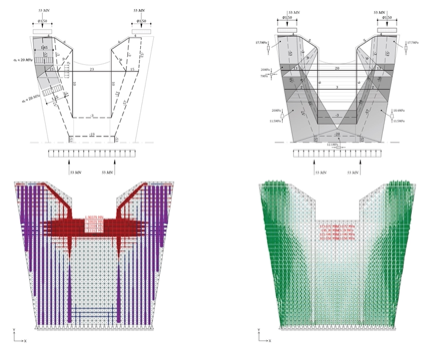
Application of strut-and-tie and stress field models for the design of the main piers of the Padre Cruz viaduct (Lisbon, Portugal)
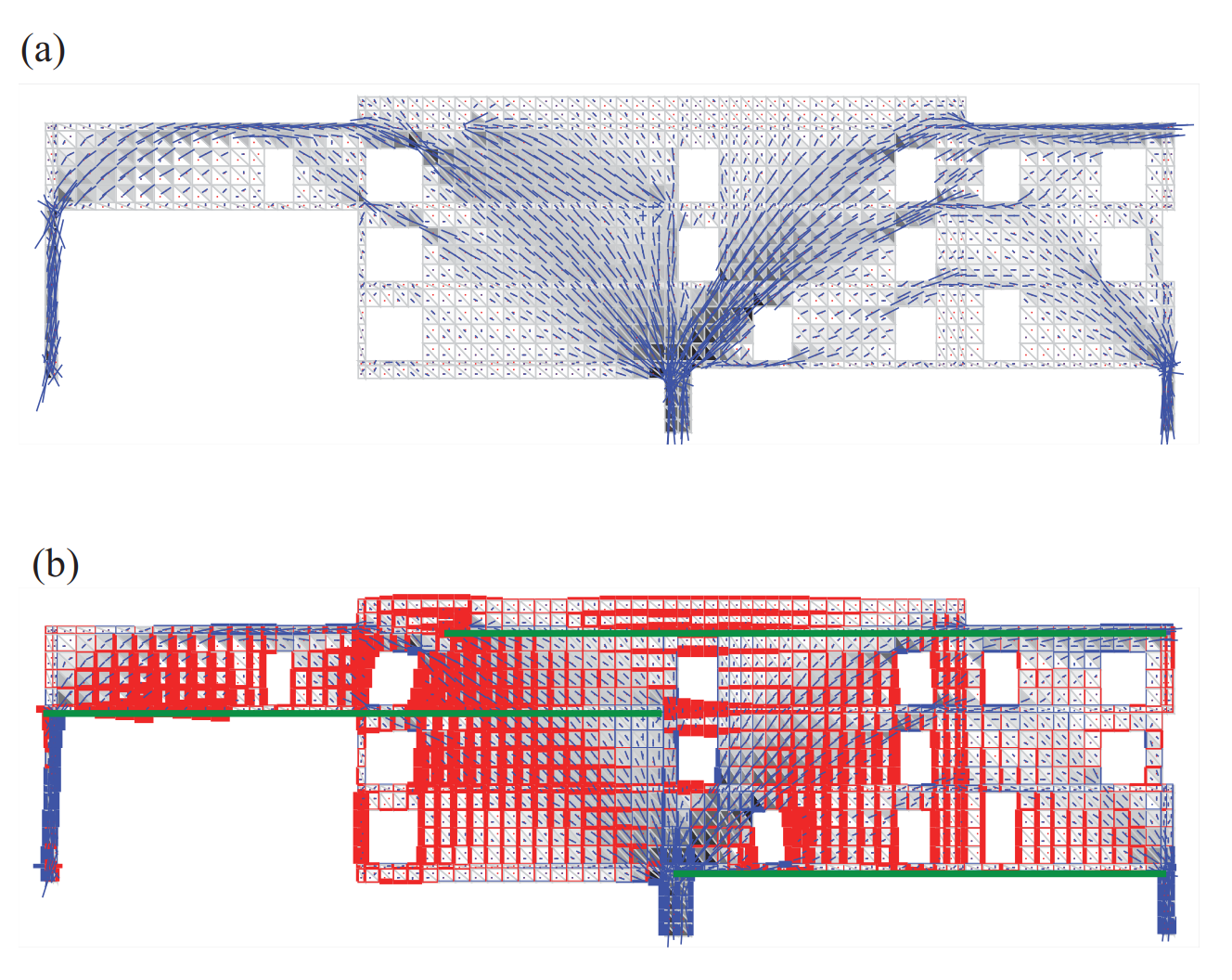
Analysis of bearing walls for Léman School (Renens, Switzerland) by means of elastic-plastic stress fields: a) compression field principal directions; (b) stresses in the reinforcement (green for post-tensioning tendons)
Level-of-Approximation approach
Another concept developed by the WP2.2.4 is the application of the Level-of-Approximation (LoA) approach to strut-and-tie and stress field modelling, i.e. the level of accuracy of strength and/or behaviour prediction, is progressively refined by successively increasing the model refinement. This is extremely useful for practical purposes and the selection of the appropriate LoA depend on several aspects: the design phase of the project (preliminary design, detailed design, etc.), on local or global structural complexity, the influence of local behaviour to global structural response, whether assessment or design of a structure is at play, etc.
The suitable design strategy and the adequate LoA for a specific case should be defined employing the required accuracy and the time devoted to the analysis. For example: for new structures, simple and safe load-carrying models are to be used. To that end, the use of strut-and-tie models with some local refinements via rigid-plastic stress fields is normally adequate. This provides a lower-bound of the actual strength and yields sufficient freedom to the designer to decide on the location on the main reinforcement, allowing ease of construction. Only when complex or critical elements are to be designed, refined analysis is justified (for instance by accounting for kinematic compatibility). On the other hand, for the assessment of existing structures, simple models (lower-bound solutions) can be used at first to identify non-critical regions (where the strength is satisfied even for the simple load-carrying models). In those critical regions in which simple lower-bound solutions do not verify that adequate strength is provided, further model refinement is justified in order to avoid, or minimise, strengthening (note that the savings in strengthening largely compensate for the cost of additional studies). Refined assessment models can be developed by accounting, for instance, for kinematic considerations. Nevertheless, it should be noted that the deformation capacity of the structure is to be verified so that plastic stress redistribution can effectively occur.
{tab PRACTICAL EXAMPLES}
Theorical and real examples
A selection of theoretical and real examples of application of strut-and-tie and stress fields is presented in this section. Several examples can be found in the existing literature, including the last fib bulletin 100. The objective of this section is to provide a more dynamic platform to be updated when needed. To account for problems encountered by practicing engineers, fib members interested in the application of these methods are welcomed to send their real project cases in the contact section; for cases considered of interest for the engineering community, WP 2.2.4 will add these cases to this practical examples section. Note that there is no necessity to give the identification data of the original project if this were not possible.
 |
 |
Practical videos
Only for members
{tab RESOURCES}
Computer software: Evals
Only for members.
EvalS is a computer software for the automatic development of 2D stress fields. Its user interface facilitates modelling and the definition of analysis options. It was developed by Miguel Pedrosa Ferreira, a member of WP 2.2.4, and its use is now available to fib members.
fib members can freely download the installation program of this software as well as some video tutorials and the files for one of the examples of the Workshop held by WP 2.2.4 in April 2022.

fib bulletins


{tab NEWSLETTER}
fib and WP 2.2.4 will organize a Webinar Workshop for 1st and 4th April 2022 (Sold out. New dates will be announced soon) on Design and assessment with strut-and-tie models and stress fields. This Webinar is aimed at being an opportunity to share knowledge on strut-and-tie and stress fields with professionals, academics and students. The webinar is organized in two afternoons. The first is devoted to reviewing classical and advanced concepts of the methods, with sufficient time for discussions and questions. The second will consist on interactive sessions where academic and real practical cases are solved by experts of the WP 2.2.4 together with the audience. This latter task will be performed with hand-based approaches and also using a specific software for stress field design (the software will be free to download and use for all attendees).
{tab VIDEOS}
Only for members
{tab ABOUT WP 2.2.4}
fib’s WP2.2.4 is part of Commission 2: Analysis & Design and Task Group 2.2: Ultimate Limit State models. It focuses on the application of strut-and-tie and stress field models for the analysis and design of reinforced concrete structures under different levels of approximation. The group is formed by structural engineers working actively both in profession and academia.
Some of the most relevant tasks of this WP are listed below:
- Writing state-of-the-art documents and scientific papers (as Bulletin # 100 of fib)
- Developing dedicated software for design based on stress fields
- Preparing webinars to spread the knowledge and enter in contact with the communities of engineers with academic and professional interests
- Drafting, reviewing and revising the MC 2020 provisions with respect to strut-and-tie and stress fields
| First name | Last name | Country | Affiliation |
|---|---|---|---|
| Almeida | João | Portugal | Instituto Superior Técnico Lisboa |
| Fernández Ruiz | Miguel | Spain | Universidad Politécnica de Madrid |
| Bousias | Stathis | Greece | |
| Fernández-Ordóñez | David | Switzerland | fib |
| Mata-Falcón | Jaime | Spain | Universitat Politècnica de València |
| Lourenço | Miguel | Portugal | JSJ Structural Engineering |
| Mihaylov | Boyan | Belgium | University of Liege |
| Hoang | Linh | Denmark | Danmarks Tekniske Universitet |
| Meléndez | Carlos | Spain | Esteyco SA |
| Faria | Duarte | Switzerland | Muttoni et Fernández, ingénieurs conseils SA |
| Pedrosa Ferreira | Miguel | Portugal | |
| Muttoni | Aurelio | Switzerland | École polytechnique fédérale de Lausanne (EPF Lausanne) |
{/tabs}